
A hole watch — OSHA calls the role a confined space attendant — is the trained person stationed outside a permit-required confined space for the whole entry: counting who is inside, watching conditions in and around the space, keeping contact with entrants, and summoning rescue when it is needed. Under 29 CFR 1910.146, a permit-required entry does not proceed without one.
“Hole watch” is the field name; “attendant” is the term the standard uses. They describe the same role: the person at the opening whose job is to keep the people inside the space safe. The attendant is not a rescuer — that distinction is written into the standard, and confusing the two is how confined space incidents multiply.
The ten duties in 1910.146(i), in plain terms
The standard lists the attendant's duties in paragraph (i). Read as a list, it describes a job of continuous attention:
- Know the hazards of the space, including how exposure shows up — the mode, the signs and the consequences (i)(1).
- Know the behavioral effects hazards have on entrants, because an entrant who is confused or disoriented may not recognize their own exposure (i)(2).
- Keep an accurate count of everyone inside, and make sure entrants can be identified (i)(3).
- Stay outside the space for the entire entry, until another qualified attendant takes over (i)(4).
- Maintain communication with entrants to monitor their status and alert them when evacuation is needed (i)(5).
- Watch activities inside and outside the space, and order entrants to evacuate immediately when a prohibited condition appears (i)(6).
- Summon rescue and emergency services as soon as entrants may need assistance (i)(7).
- Keep unauthorized people away — warn them off, tell them to stay out, and report them (i)(8).
- Perform non-entry rescue where the employer's program allows it, using retrieval equipment without going in (i)(9).
- Do nothing that interferes with the primary duty of monitoring and protecting the people inside (i)(10).
Which of these can continuous monitoring equipment carry?
Duties (i)(1), (i)(2) and part of (i)(8) are judgement and authority — they stay with a person. But a meaningful share of the watching in (i)(3), (i)(5) and (i)(6) is exactly where equipment helps most, because it removes the failure mode nobody talks about: an attendant who is watching a portable display across the space, or leaning into the opening to read a screen inside.
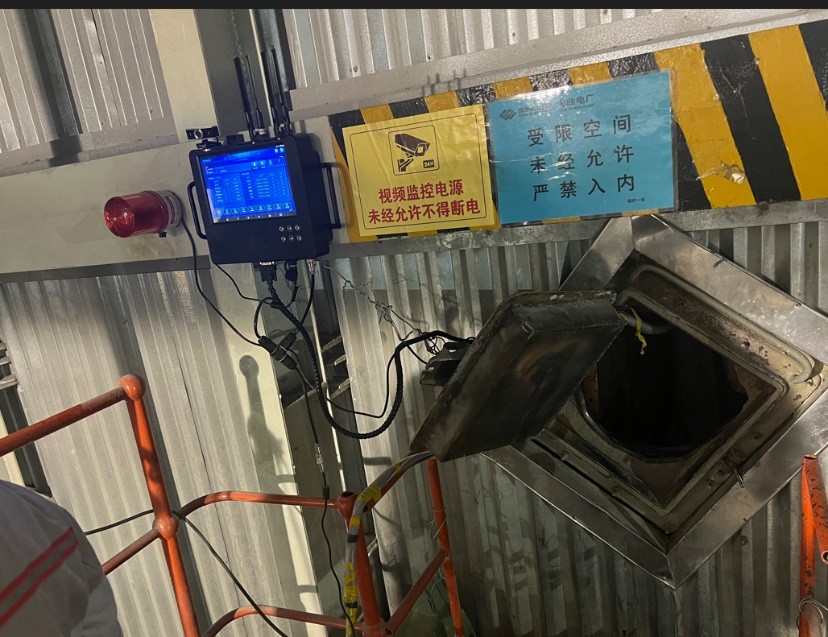
- Atmosphere, continuously and at the entrance. A fixed monitoring station at the hatch keeps the gas readings where the attendant actually stands, so following the readings does not mean leaning into the space — which is itself a violation. This supports the observational part of (i)(6).
- Headcount that updates itself. Wearable identification devices let the count in (i)(3) update continuously — who came in, how many are still inside — instead of relying on a tally kept by memory during a busy shift.
- Alarms that reach everyone at once. When a reading goes out of range, a connected system alerts the entrants, the attendant and the safety platform at the same time, instead of the information travelling at the speed of a shout.
The honest framing: equipment carries the watching; the attendant keeps the deciding.
What no equipment can take over
Three duties cannot transfer to a device, and any serious equipment proposal says so:
- The authority to order evacuation (i)(6) and to summon rescue (i)(7) belongs to the attendant.
- Non-entry rescue (i)(9) — operating the retrieval line and winch — is a physical task for a person.
- The attendant must stay at the space until relieved (i)(4). A monitoring system extends what one attendant can see; it does not make the attendant optional, and the permit still requires one.
When one attendant can cover an entry with confidence
Where the geometry is favourable — a single hatch, deep vertical spaces, a crew boarding through one point — a station that shows concentration curves, headcount and live status at the entrance lets the attendant supervise with full information instead of partial glimpses. On shipboard enclosed spaces, where hatches are small and compartments are deep, this is often the difference between an attendant who is informed and one who is guessing. Our shipboard configuration note covers this geometry in detail.
A system that cannot display data at the point of entry adds little for the attendant — if the readings end up on a screen nobody at the hatch can see, the duty in (i)(5) is no better served than before.
Questions buyers ask
Is “hole watch” the same as “confined space attendant”?
Yes. “Hole watch” is the common field term; “attendant” is the term
used in OSHA 29 CFR 1910.146. Some crews also say “top man” or “standby
person”. The duties are the same.
Can a hole watch enter the space to rescue someone?
No. The attendant performs non-entry rescue where the program allows it (i)(9) and summons
rescue services (i)(7). Entry rescue belongs to trained rescue teams meeting the requirements
of paragraph (k). An attendant who goes in becomes the next casualty.
Does a monitoring system remove the need for an attendant?
No. It removes blind spots and distance: readings at the entrance, a headcount that updates
itself, alarms that reach everyone at once. The duties in paragraph (i) remain with a person,
and the permit still requires one.
About Yunku Technology
Yunku Technology manufactures confined space entry monitoring stations and smart safety harnesses, and builds the sensing, communication and platform layers for both. Our confined space monitoring station brings gas readings, headcount and alarms to the point of entry, with edge-based alarming that keeps working when the network does not.