
What makes this hard
Height work inside classified areas
Derricks, distillation columns, furnace roofs, absorber internals and tank tops are all height work, and most of them sit inside zones where non-rated electronics cannot be used. A monitoring device that is not explosion-proof is not an option, whatever its specification.
Attachment devices differ per trade
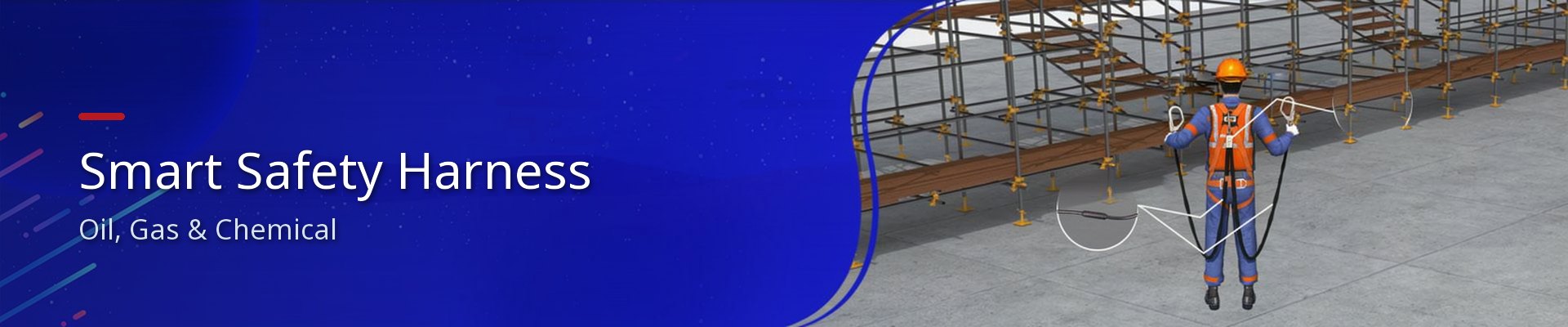
Rig crews use double hooks and fall arresters; maintenance crews use secondary lanyards; a single-lanyard monitoring device misses most of what actually happens on site.
Short-duration, high-frequency exposure
Gauging a tank roof or checking a burner takes minutes. That is precisely the exposure pattern where harness use is skipped, because the task feels too brief to justify the setup.
Contractor and turnaround surges
Turnarounds bring in large contract workforces, working to schedule in unfamiliar plant, which is where height violations cluster.
What we deploy
In a hydrocarbon plant, working at height and working in a classified area are usually the same job — which constrains the equipment you can bring to it as much as it constrains the work itself.
- SBM3000 multi-state monitor recognising pole strap, secondary lanyard, double hook, fall arrester and self-locking device
- Explosion-proof rating Ex ib IIC T4 Gb with IP65 protection for outdoor and washdown environments
- Automatic height detection above 2 m — monitoring begins without the worker registering anything
- Optional 110 dB external speaker announcing the violation on site where the crew needs to hear it
- Three-level alarm escalation: wearer buzzer, supervisor and safety officer notification, plant platform
- On-premise platform deployment available where data must remain inside the plant network
What changes on site
Equipment that is permitted in the zone
The constraint that rules out most smart-harness products in a hydrocarbon plant is the area classification. Intrinsically safe hardware means the benefit is available where the work actually is.
One device across trades
A single monitor covering five attachment devices can be issued plant-wide, which simplifies procurement, spares and the training that goes with it.
Short tasks are covered too
Automatic height detection means a two-minute tank roof check is monitored identically to a two-day column overhaul, which removes the category of task most often left out.
Violations that are heard, not filed
The on-site announcement makes the correction immediate and visible to the crew, which changes behaviour in a way that a report issued a week later does not.
Frequently asked questions
Is the harness monitor certified for use in a classified area?
The monitor is rated Ex ib IIC T4 Gb with IP65 ingress protection, and the accompanying harness complies with GB 6095-2021. Send us your zone classification and we will confirm suitability in writing before you order — this is a question where an assumption is worth avoiding.
How does one device cover so many attachment devices?
The SBM3000 uses a multi-axis posture sensor plus on-device edge computing to classify the state of five different attachment devices — pole strap, secondary lanyard, double hook, fall arrester and self-locking device — rather than assuming a single standard lanyard.
Can the platform run inside our own network?
Yes. On-premise deployment is supported and the platform can integrate with existing plant systems, so position and alarm data need not leave the site.
What is the lead time for a turnaround-scale rollout?
Give us the crew numbers and the attachment devices in use, and we will confirm a delivery date rather than a range. Units are issued with the harness, so rollout is a kit issue rather than a construction project.